
Broadcasting tech in 2023: industry predictions

20 December 2022


Broadcast spoke to Miroslav Jeras, Pebble CTO about his 2023 predictions in broadcast tech: “Broadcasters can deploy IP-based channels with less hardware whilst leveraging preferred workflows and with increased flexibility to launch and decommission event/pop-up channels quickly. The importance of hosting this operational infrastructure in a standard data centre environment is key. However, the transition […]

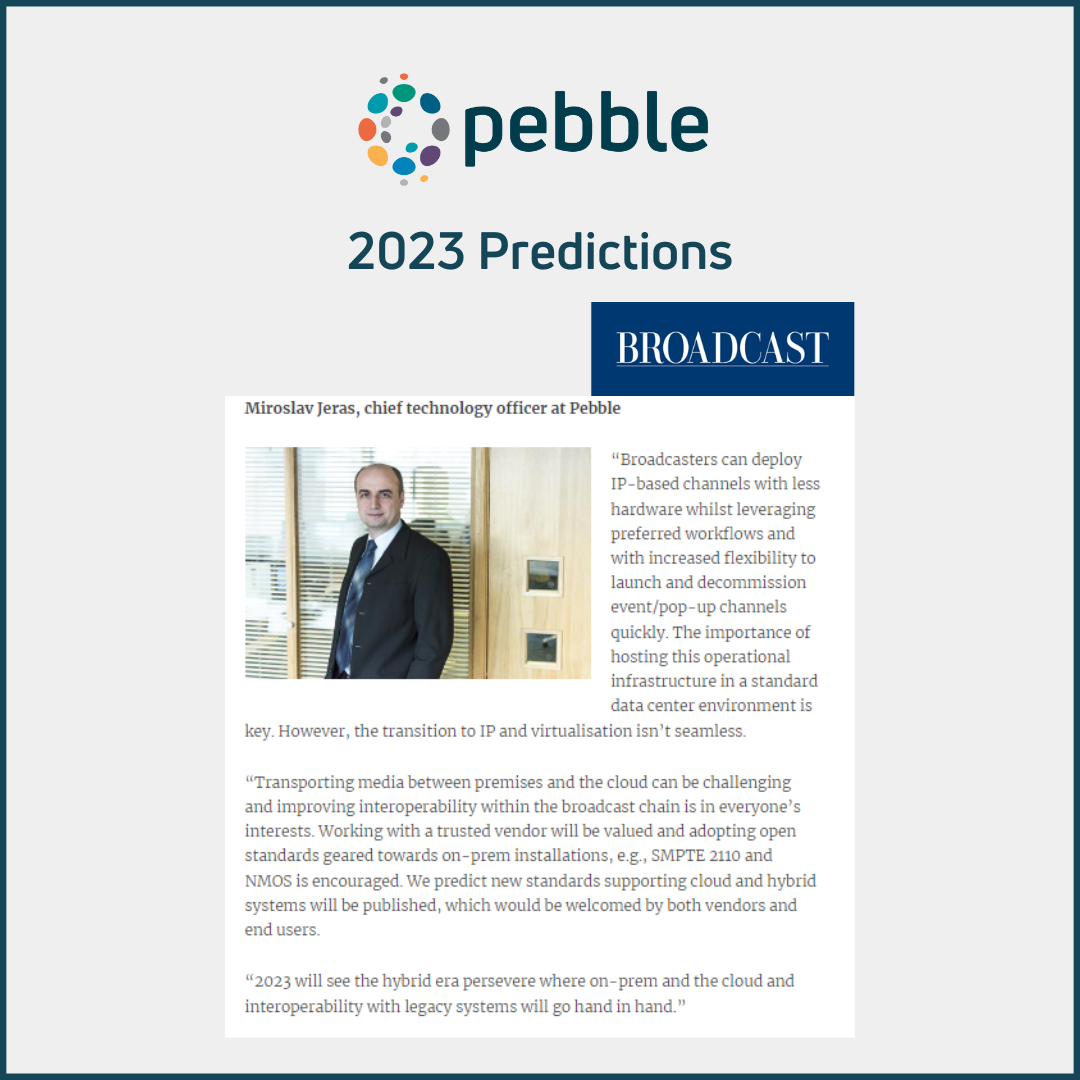
Broadcast spoke to Miroslav Jeras, Pebble CTO about his 2023 predictions in broadcast tech:

“Broadcasters can deploy IP-based channels with less hardware whilst leveraging preferred workflows and with increased flexibility to launch and decommission event/pop-up channels quickly. The importance of hosting this operational infrastructure in a standard data centre environment is key. However, the transition to IP and virtualisation isn’t seamless.

“Transporting media between premises and the cloud can be challenging and improving interoperability within the broadcast chain is in everyone’s interests. Working with a trusted vendor will be valued and adopting open standards geared towards on-prem installations, e.g., SMPTE 2110 and NMOS is encouraged. We predict new standards supporting cloud and hybrid systems will be published, which would be welcomed by both vendors and end users.

“2023 will see the hybrid era persevere where on-prem and the cloud and interoperability with legacy systems will go hand in hand.”

Read the 2023 predictions of industry peers HERE.


Latest news

Pebble brings future-ready playout innovation to BroadcastAsia 2026

Epsom, Surrey, UK, 12 May 2026: Pebble, the leading automation, content management and integrated channel specialist, is exhibiting at BroadcastAsia 2026 (stand 5J1-9 Singapore Expo, 20-22 May 2026). The show provides an opportunity to meet the team behind some of the most advanced playout deployments in the world, including a recent project with leading Taiwanese […]

READ FULL ARTICLE

Where AI really fits in broadcast operations

For several years, artificial intelligence has dominated industry conversation. Nearly every new tool, platform or workflow arrived with an AI label attached. As with most technological waves, the early stage was defined as much by expectation as by practical reality. As we move through 2026, that conversation is beginning to settle. AI is transitioning from […]

READ FULL ARTICLE

Why broadcast technology is no longer the hard part 

For most of broadcasting’s modern history, progress was defined by technical constraint. Could systems stay on air without interruption? Could devices be synchronised precisely? Could storage, processing and networking cope with growing channel counts? For decades, competitive advantage came from overcoming engineering limitations. If you could make the technology work seamlessly, you were ahead. Today, […]

READ FULL ARTICLE