
Why having the flexibility of the cloud with the confidence on-premises is the way forward
It is clear the future of broadcast is IP. And it is inevitable that broadcast operations, including media playout as well as media capture, management and delivery, will ultimately be based on cloud technologies.
Making the transition to IP will allow broadcasters to scale and adapt easily, giving them the flexibility to configure and manage devices as well as workflows. With the ability to quickly spin up new services, they’ll be able to meet the ever-changing demands of audiences for engaging content. And now, cloud technologies are at the point of hitting cost efficiencies where it can make sense for certain workflows to exist fully in the cloud. By using computing and processing that scales upon demand, companies only pay for the capacity they need, when they need it. Organisations can immediately free up their capital budgets and re-invest their money to generate new revenue.
And that’s only the beginning. The broadcast landscape is clearly changing, with streaming and video-on-demand services growing more popular. The growth of newer streaming AVOD services and rapidly growing models like Free Ad-Supported Streaming TV (“FAST”) services, make the case for the cloud even stronger.
Content owners need to act and respond efficiently to prepare and distribute their content to a growing number of platforms. Cloud computing lets facilities work on thousands of files simultaneously, with the ability to scale up or down at any time depending on their production workload. Reacting and distributing content to these platforms faster, means more potential content monetisation opportunities.
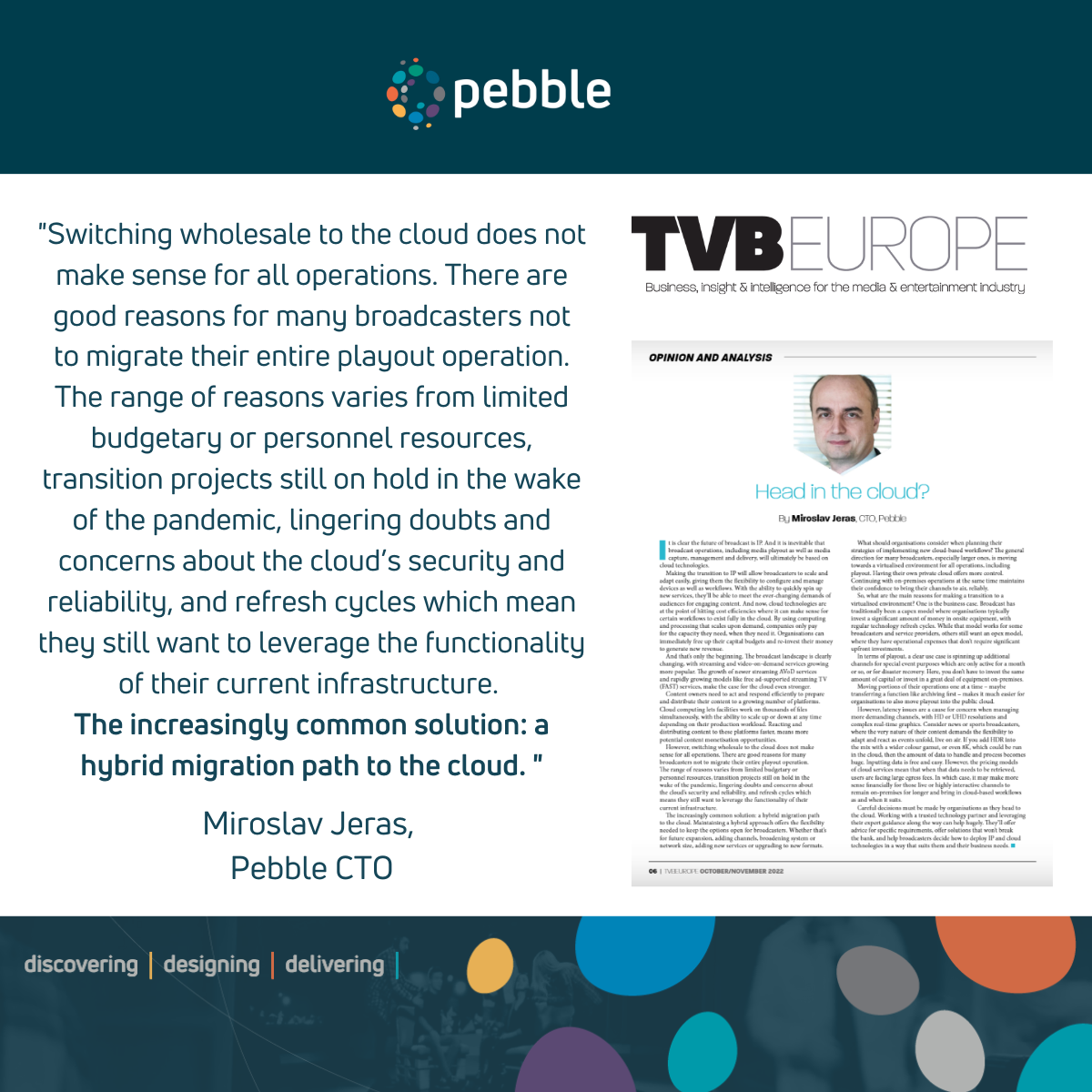
However, switching wholesale to the cloud does not make sense for all operations. There are good reasons for many broadcasters not to migrate their entire playout operation. The range of reasons varies from limited budgetary or personnel resources, transition projects still on hold in the wake of the pandemic, lingering doubts and concerns about the cloud’s security and reliability, and refresh cycles which mean they still want to leverage the functionality of their current infrastructure.
The increasingly common solution: a hybrid migration path to the cloud.
Read the article on Page 6 in full HERE.