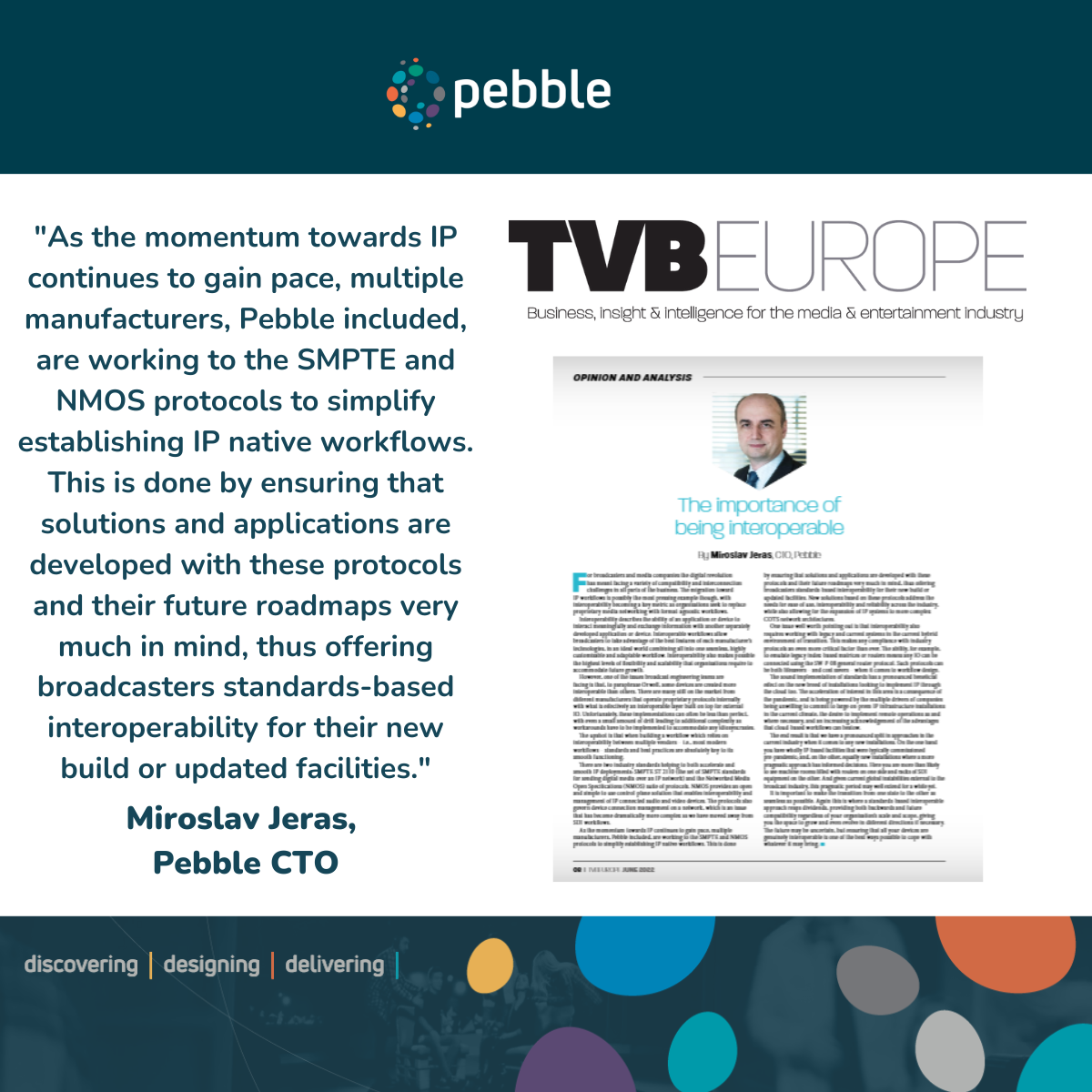

Full page article featured in the June 2022 issue of TVBEurope
For broadcasters and media companies the digital revolution has meant facing a myriad of compatibility and interconnection challenges in all parts of the business. The migration toward IP workflows is possibly the most pressing example though, with interoperability becoming a key metric as organisations seek to replace proprietary media networking with format-agnostic workflows.
Interoperability describes the ability of an application or device to interact meaningfully and exchange information with another separately developed application or device. Interoperable workflows allow broadcasters to take advantage of the best features of each manufacturer’s technologies, in an ideal world combining all into one seamless, highly customisable and adaptable workflow. Interoperability also makes possible the highest levels of flexibility and scalability that organisations require to accommodate future growth.
However, one of the issues broadcast engineering teams are facing is that, to paraphrase Orwell, some devices are created more interoperable than others. There are many still on the market from different manufacturers that operate proprietary protocols internally with what is effectively an interoperable layer built on top for external IO. Unfortunately, these implementations can often be less than perfect, with even a small amount of drift leading to additional complexity as workarounds have to be implemented to accommodate any idiosyncrasies.
The upshot is that when building a workflow which relies on interoperability between multiple vendors — i.e., most modern workflows — standards and best practices are absolute key to its smooth functioning.
Read the article on Page 8 in full HERE.