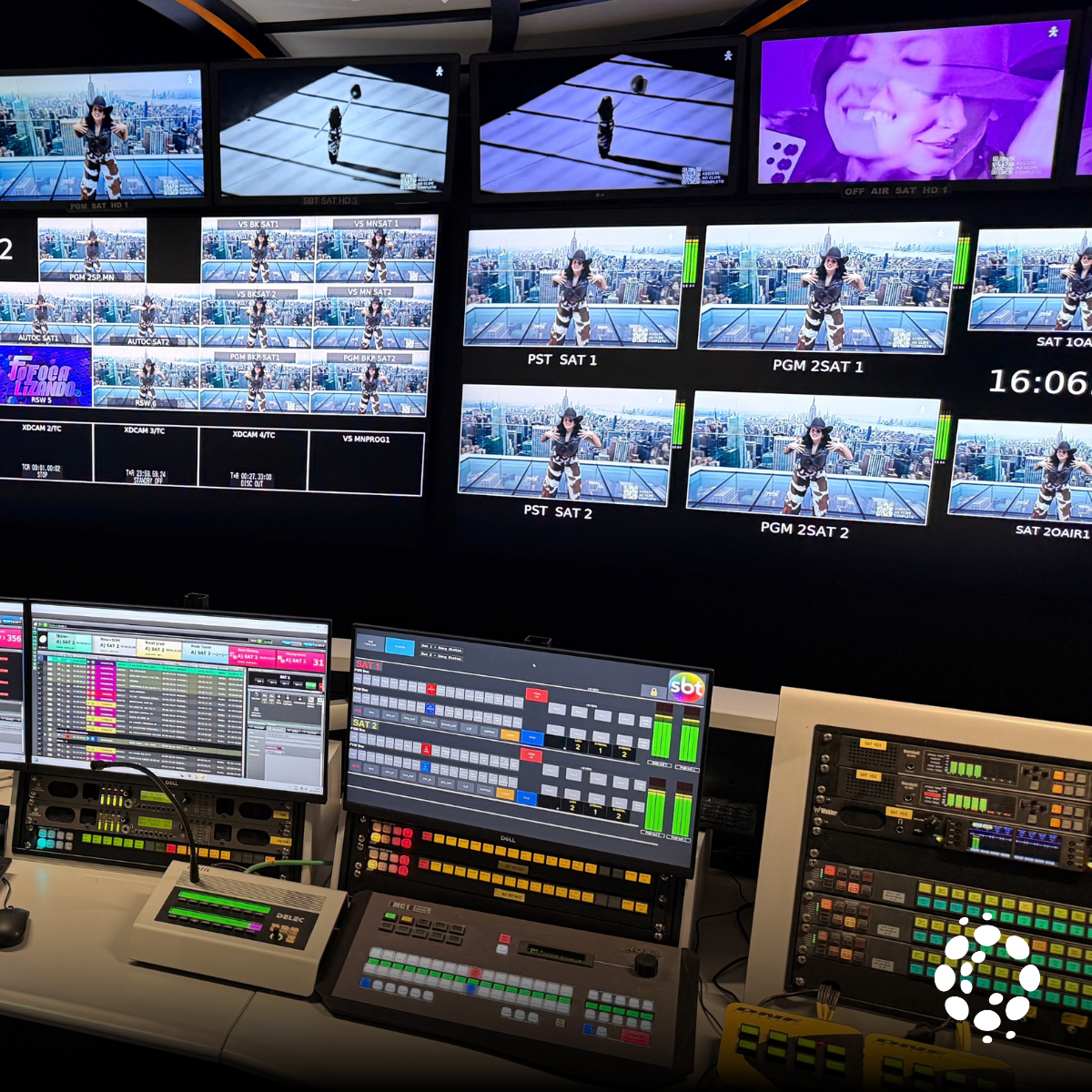
Epsom, Surrey, UK, 22 May 2025: Pebble, the leading automation, content management and integrated channel specialist, has implemented a complete, software-defined playout architecture for Brazilian broadcaster Rede Minas. The new system allows much more sophisticated and tailored playout across multiple channels.
Rede Minas is the government-owned public broadcaster for the state of Minas Gerais, in central Brazil. It broadcasts from its production base in Belo Horizonte, across a very large footprint, using terrestrial, satellite and streaming distribution.
Seeking to replace a life-expired playout infrastructure, Rede Minas looked to add functionality, capacity and capabilities with the new solution. To meet these goals, it selected a turnkey solution from Pebble, including its proven and popular Automation, paired with Integrated Channel devices to replace the legacy playout hardware.
As well as being very cost-efficient, the Pebble Integrated Channel devices save considerable rack space and power consumption with consequent air conditioning. For Rede Minas, this meant it could expand its output, adding three education channels as well as providing tailored services for terrestrial, satellite and streaming.
Each Integrated Channel device has dual independent outputs, which Rede Minas is using to provide opt-outs for some regions within its territory, to serve local interests and regulation. The Pebble Automation layer ensures that the correct content for each output is loaded and quality checked before transmission.
“We needed to make the move to a modern playout environment, but we knew it would be a significant undertaking for us,” said Caroline Santos, Director of Technology at Rede Minas. “Pebble and their local distributor Videodata were able to show us, through a proof of concept demonstration, how its software systems could deliver all we needed and more.
“What was really important, though, was that they were able to manage the entire project,” Santos continued. “That included transferring all the data from our current asset management and integrating seamlessly with our planning workflows. It meant that the switchover was accomplished quickly, cleanly and without problems.”
Rosalvo Carvalho, General Director at Videodata said “We have a long and successful relationship with Rede Minas. The modernisation of playout was a very important project for them, and while as a government body the procurement was by public tender, we introduced them to Pebble as a globally-renowned automation specialist.
“Ultimately we all collaborated on a comprehensive proof of concept exercise which answered all of their concerns,” he added. “The result is transformational for Rede Minas, through a project which respected the need to minimise disruption to existing operations. We are all very proud of how well the implementation and subsequent operation went.”
For more information on Pebble Automation, Integrated Channel and other solutions, see www.pebble.tv.
### ENDS ###