testttt

Pebble launches Freemium version of Pebble Control

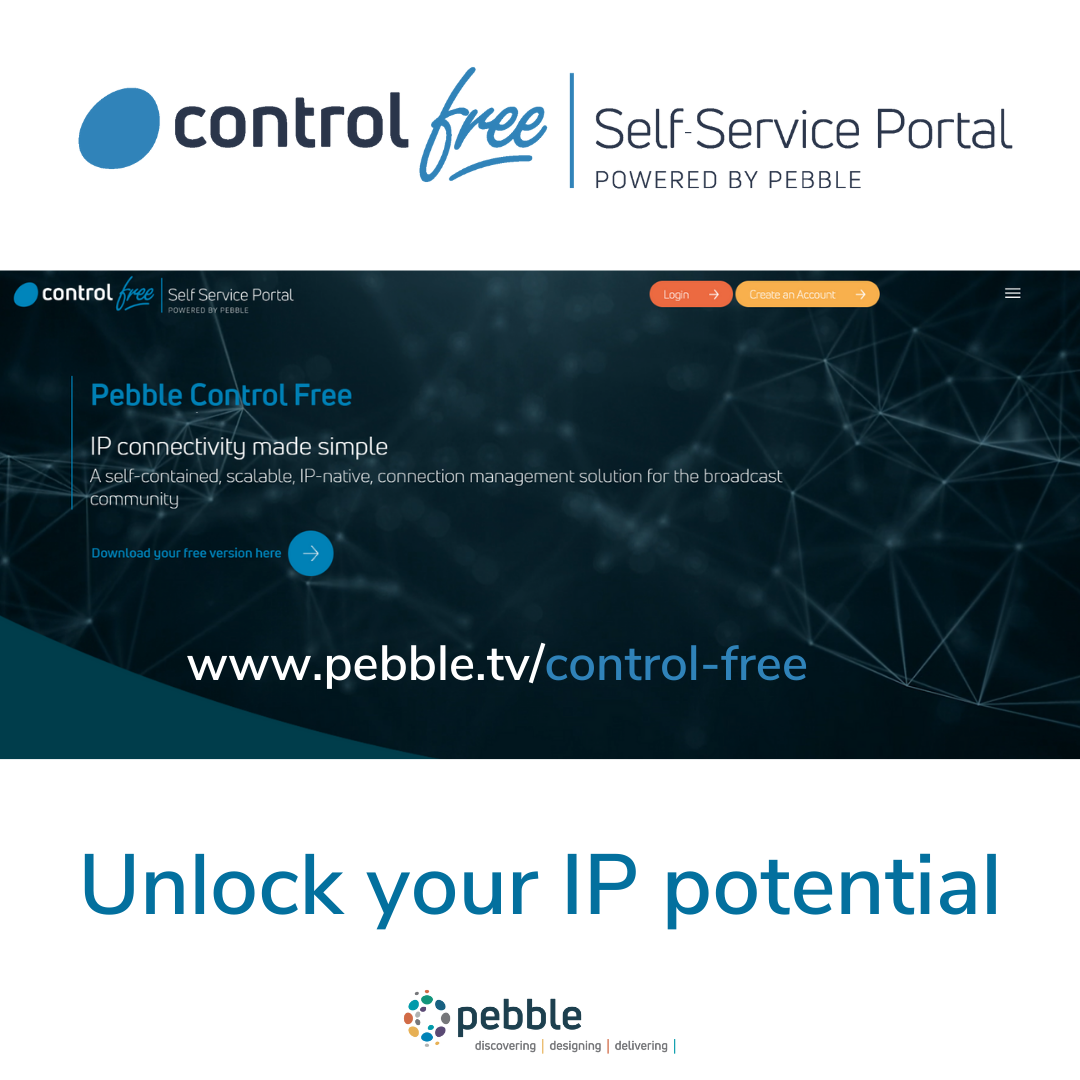
Pebble Control Free is designed to “democratise” IP and hybrid broadcast environments, bringing IP connection management capabilities to a wider audience through Pebble’s new self-service portal.

Weybridge, Surrey, UK –  21 April 2022: Pebble, the leading automation, content management, and integrated channel specialist, is launching a freemium version of Pebble Control, its self-contained, scalable, and easy to configure IP connection management system. Pebble Control Free is available to download from Pebble’s new self-service portal, giving the broadcast community the ability to take their first steps into IP autonomously.

The freemium version is designed to support broadcasters and production facilities of any size as they manage their transition from traditional broadcast infrastructures to more flexible IP-based technologies. It offers many of the same capabilities as Pebble Control but on a more modest scale, allowing users to explore their journey into IP in a way that works for them.

“Broadcasters and production facilities are under intense pressure to deliver new programming to a changing audience while dealing with increased competition from new services and content platforms,” said Miroslav Jeras, CTO at Pebble. “They’re doing all this while managing their own internal resources as they explore transitioning to an IP infrastructure. Each broadcaster or production facility is at a different point in their journey, so having the ability to implement a small scale system enables them to upskill their teams, gain experience in how to build and operate these technologies, and test new ways of working.”

Pebble Control offers IP connection management at any scale without the need to deploy a bespoke enterprise solution. It leverages full support for the NMOS (Networked Media Open Specifications) suite of protocols – produced by the Advanced Media Workflow Association to facilitate networked media for professional applications – and operates on web-based UIs. Designed to deliver immediate benefits to even the smallest IP facility, it interfaces with NMOS-enabled devices from multiple vendors on the network and is easily reconfigurable for when interconnections change or when devices are added or removed, essentially providing plug and play capability for IP networks. This new version, Pebble Control Free, allows users to seamlessly leverage interoperability in an IP world. They can test the waters and explore how easy it really is to manage and connect IP devices using the resources available on Pebble’s new self-service portal.

Alison Pavitt, Director of Sales and Marketing at Pebble commented: “Pebble has long championed the importance of open standards and Pebble Control Free is set to drive collaboration across the industry. Available free of charge to end users and vendors alike, it fills an important gap in the technology stack and makes IP connectivity as simple as SDI. As a successful specialist vendor with 22 years’ experience of listening to what the market needs, we’re happy to be giving back with this important tool which democratises access to IP and is set to drive collaboration across the industry.”

For more information and to download the software, visit www.pebble.tv/control-free 

### ENDS ###
AWS partner status

testttt

Pebble Joins the AWS Partner Network and Achieves Certification of its Virtualised Playout Solution

Following completion of the AWS Foundational Technical Review (FTR) for its Virtualised Playout Solution, Pebble accelerates its engagement with the AWS community to promote cloud solutions to its global customer base.

Weybridge, Surrey, UK , 13th April 2022: Pebble, a leading automation, content management, and integrated channel specialist, is delighted to announce it has joined the Amazon Web Services (AWS) Partner Network (APN) and completed the cloud provider’s Foundational Technical Review (FTR) program for its Virtualised Playout solution.

Pebble will leverage its AWS Partner status and AWS FTR certification to work closely with the AWS community, identifying new customer-focused solutions that follow AWS best practices for scalable cloud workflows, security, performance, and operational efficiency.

Peter Mayhead, Chief Executive Officer at Pebble said: “More and more broadcasters are navigating the best route to leveraging cloud solutions that are suited to their operations both practically and financially. And to do this they need a technology partner they can trust. I’m incredibly proud of the efforts made by the teams at Pebble for having passed such a rigorous process to successfully complete the AWS Foundational Technical Review and achieve AWS Partner status. This success shows our growing customer base that we are certified experts in our field and committed to delivering cloud solutions that will work for them.”

The Pebble Virtualised Playout Solution is a software-defined virtualised IP channel with a flexible channel pipeline design. The benefits of virtualised playout include the agility to launch and decommission channels for short-term requirements, and the ability to host an operational infrastructure within a standard data centre environment.

As a software-only implementation of Pebble’s Integrated Channel device, the Virtualised Playout solution is configurable to meet the exact requirements of each of the channels a customer needs to play out. It is designed to meet the needs of service providers, multi-channel operators, sports broadcasters, and corporate users looking to virtualise their operations.

“While the future of media playout and control is clearly headed toward the cloud, not all organisations are ready to fully move away from their on-premises, legacy-based infrastructures,” said Daniel Robinson, Head of R&D at Pebble. “By working with the AWS community, we will greatly enhance our ability to develop and customise cloud solutions for broadcasters, and we can especially cater for those who are not ready to make the leap to full cloud playout, offering hybrid solutions that will allow them to migrate at a pace that makes the most sense for the long-term success of their operations.”

Pebble is also now an AWS Independent Software Vendor (ISV) joining that customer-centric community to extend the reach of AWS and provide customers with expanded workflow options.

### ENDS ###

testttt

FEED Magazine | Spring 2022 Issue | Being Smart About IP

As you make the move to IP – and you will – a careful inventory of what you already have is essential

IP-based workflows offer greater flexibility for running your facility – even in terms of how much IP you want to bring on board. This isn’t an either/or proposition. The best approach is to look at what you have, then make the choices that are going to help you get where you want to go.

“When the question comes up about how to incorporate IP technology, I have to ask first: What do we mean by IP?” says Miroslav Jeras, CTO of Pebble. “There can be IP signal distribution within a facility with SMPTE 2110 inputs and outputs that replaces an SDI infrastructure. But there are people who also want to use public cloud – I would call that a different variety of IP.”

The pandemic’s interference with business as usual has resulted in the slowing down of big, on-premises IP infrastructure installations – and a rapid acceleration of IP through the cloud. Even on-premises upgrades adapted to working remotely, notes Jeras, with increased demand for web-based control and monitoring solutions, like Pebble Remote: “Eventually, everything will be IP-based. The question you need to ask is, do you need to make the spend on those new technologies right now?”

Getting rid of old infrastructure is a bit like moving away from fossil fuels to power your vehicles – you know you’re going to do it eventually, but will it be this year? To extend the analogy further, do you lease or use public transport before making the next purchase?

With a big IP replacement movement, there could be significant costs if building a new infrastructure on-premises, and there’s the need to retrain engineers still working in the SDI world to consider. If you aren’t locked into already-existing infrastructure, it might make sense to look to a future that employs more cloud-based options.

Click HERE to read the article in full.