testttt

The real question behind every playout decision

Selecting a playout system is a decision that reaches far beyond a technical comparison. Pebble’s SVP Sales, Sally Wallington, explores what broadcasters really need from their technology choices, from proven reliability and operational confidence to a supplier that understands the pressures of running mission-critical services.

With commercial pressure increasing and technology choices expanding, broadcasters are looking beyond features and upfront cost. They need to understand how a platform will perform when something goes wrong, when requirements change, and when the people who know a system best move on. Sally looks at the hidden costs of complexity, the balance between building and buying technology, and why being truly future-ready is about much more than having the right architecture or technology label.

Ultimately, she considers why evidence, experience and long-term trust matter just as much as the technology itself, and why the real measure of a playout decision is whether it still feels like the right one years down the line.

Read the full article in BroadcastProME.

### ENDS ###

testttt

Asharq migrates extended channel line-up to Pebble playout

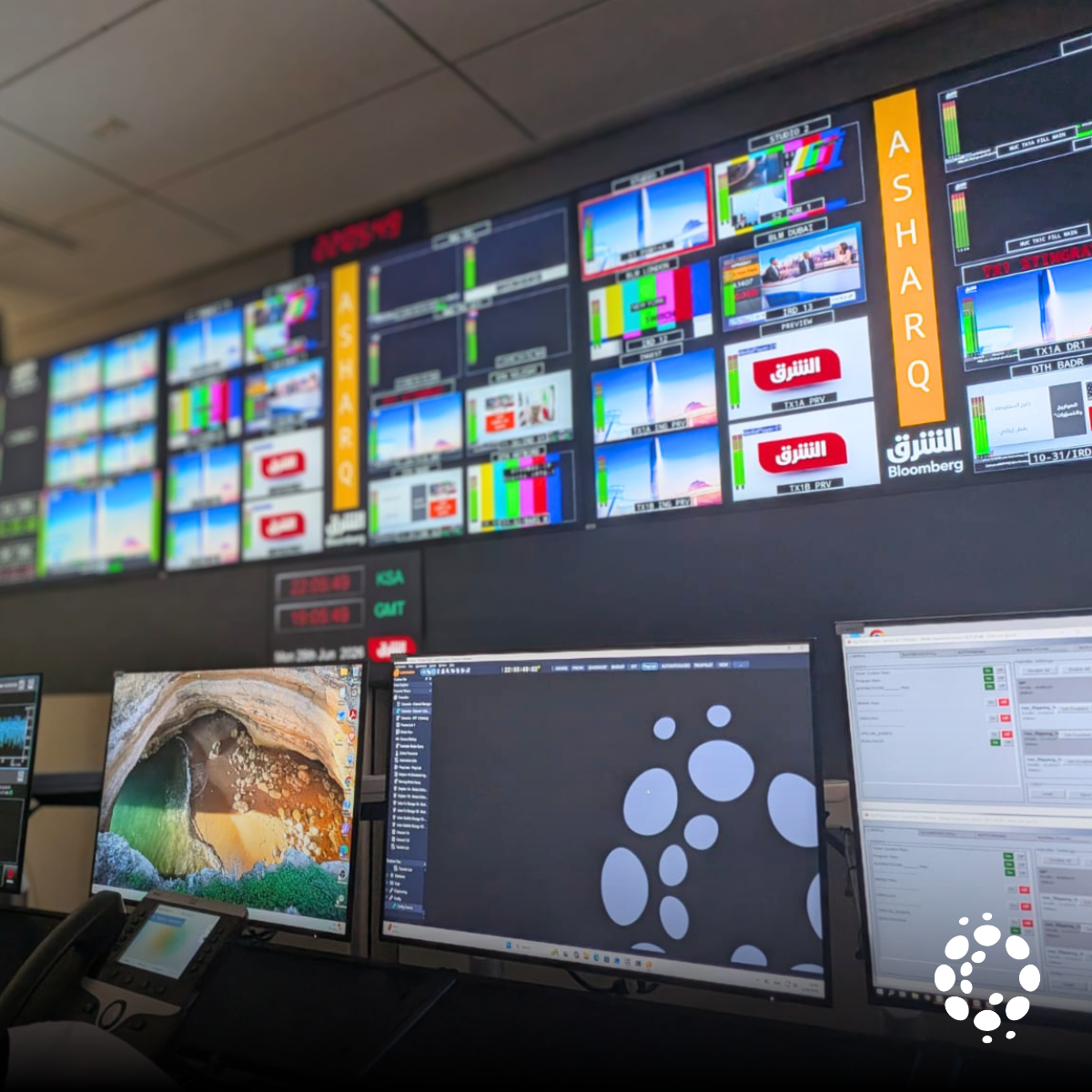
Epsom, Surrey, UK, 9 September 2026: Pebble, the leading automation, content management and integrated channel specialist, is extending its relationship with Asharq, the pan-Arabian broadcaster which is part of the Saudi Research and Media Group (SRMG). The latest developments include moving all Asharq channels from Dubai to KAFD in Riyadh, adding the high-profile Asharq Culture channel, and bringing Thmanyah channels 1-3 onto Pebble playout to support live events.

Asharq launched its first service, Bloomberg Asharq, using Pebble playout systems in 2020, when it built its first IP ST 2110-based playout centre in Dubai, subsequently adding more services. As part of its latest expansion, Asharq has now consolidated its playout operations in the King Abdullah Financial District in Riyadh, Saudi Arabia. The Riyadh facility accommodates Bloomberg Asharq News, Asharq Discovery, Asharq Documentary and the recently launched Asharq Culture Channel. Last year, Thmanyah, also part of the SRMG group and a sister company to Asharq, won the rights to the Saudi Premier League and asked Asharq to provide the facilities for its sports channels.

The performance of Pebble Automation and Integrated Channel at Asharq UAE over the last few years led to the decision to use the Pebble platform for Thmanyah channels 1-3. The three sports services went on air on 13 August 2026 and are designed to support the demands of live events.

“Thmanyah taking over the rights to Saudi Premier League football called for even more precise performance from our central control facilities,” said Omran Abdullah, VP Engineering IT and Technology SRMG News at Asharq. “We needed complete operational control to be able to react to the unpredictable nature of sport, together with instant response from the system.

“Pebble has been a strong partner since 2019, keeping our systems up to date with the latest developments and delivering excellent performance,” Abdullah said. “That experience gave us confidence as we moved the Asharq operation to Riyadh and added the three Thmanyah sports channels to the platform.”

“This is a very important project for Pebble,” said Samir Isbaih, VP Sales – Middle East and APAC at Pebble. “Asharq has deployed Pebble’s enterprise solution on-premises at its Riyadh facility, bringing its established channel line-up together with the three Thmanyah sports services. Particularly for premium live sports, the intuitive, responsive and resilient nature of our proven platform delivers against the dynamic and complex requirements of sports channels. Key capabilities include originating digital and terrestrial outputs from the same playlist, with content and ad replacement; advanced functionality including SCTE, DVB subtitles, XAVC support, HDR and SDR; minimal video encoding delay throughout the Pebble software transmission chain; a cost-effective CAPEX offering; native ST 2110 I/O, with support for SDI and NDI on the same server as required; and superior N+N+N redundancy.

“We are delighted to be able to extend our partnership and play our part in Asharq’s continuing growth and success.”

### ENDS ###

testttt

Where does playout goes next? 

In this Q&A with Production360, Pebble CEO Peter Mayhead discusses how playout is evolving as broadcasters take a more practical approach to cloud, hybrid deployment and software-defined infrastructure. He shares his thoughts on where customers are focusing their investment, the role of standards and interoperability in shaping future systems, and how Pebble is continuing to develop its technology while protecting the reliability and workflows that established broadcasters depend on.

Is hybrid becoming the settled model for modern broadcast operations? Where can AI genuinely add value without introducing uncertainty? And how can greater interoperability give broadcasters more freedom to choose the right technology for each part of their operation?

Peter addresses these questions and more, sharing his perspective on the technology trends shaping playout today and what they mean for Pebble’s own product direction.

Read the full interview in Production360.

### ENDS ###

testttt

Keeping operational software running 24/7 

By Miroslav Jeras, CTO, Pebble

A lot of software development is about things users will never see, and in many ways that is exactly how it should be.

Pebble Remote provides a web-based interface for monitoring, managing and controlling playout environments, often across multiple channels and sites. For the people using it, the important thing is that it is there when they need it and continues to behave as expected, however long it has been running.

That makes maintaining it rather different from working on a typical web application. A browser application used occasionally can usually be restarted without much consequence. Software sitting in a broadcast control environment may be open continuously for days or weeks, receiving live information throughout that time. Small problems that would barely register elsewhere can therefore become significant.

Designing for continuous operation

Much of our recent engineering work on Remote has focused on exactly those kinds of issues. One example is memory management. Over time, we found several cases where subscriptions to real-time data, or the event listeners associated with them, could remain active after the part of the application that created them was no longer needed.

The individual issues could be fixed, of course, but seeing the same sort of behaviour in more than one area told us that there was a broader question to address. Rather than continue dealing with each instance separately, we looked again at how subscriptions are created, tracked and closed across the application.

That is an important distinction when developing software for continuous operation. Sometimes fixing the fault in front of you is enough; at other times, the fault is an indication that the underlying approach needs attention.

Remote depends heavily on live data, since operators need to see what is happening across their channels as it happens. The application therefore maintains ongoing subscriptions to automation and channel events instead of simply checking for new information every so often.

In practice, that brings its own complications. A connection can still appear to be active even though updates have stopped arriving; a component can subscribe repeatedly when it should not; or a subscription that is no longer required may continue consuming resources in the background.

These are not always dramatic failures, and that is part of the difficulty. If an application stops completely, it is obvious that something has gone wrong. If it remains open but is no longer showing current information, the problem can be much harder to spot.

As a result, we have spent time improving not only the way these connections are managed, but also the feedback provided when something does go wrong. If a live feed is no longer behaving as expected, the operator needs to know about it rather than being left with an interface that appears to be working normally. The result is not necessarily a change an operator will immediately notice, but a more consistent approach to managing the live connections that Remote relies on, and clearer feedback when those connections are interrupted.

Keeping security current

Security work follows much the same principle. It is part of maintaining software, not something that can be completed once and then left alone.

The technologies underneath an application continue to change. Supported versions move on, libraries are updated and new vulnerabilities are identified. Keeping software current therefore means reviewing those dependencies regularly rather than waiting until they become a larger problem.

Over the past year, that has meant upgrading core components used by Remote, including Node.js, database libraries and container components. We have also reviewed HTTPS and certificate handling, the management of sensitive configuration information, WebSocket communications and installer permissions.

There is always a balance to be struck here, because engineering time spent updating a library or changing the way a background process works is time that cannot be spent adding something new to the interface. Much of that work may never be particularly visible to customers either.

For software used in a live broadcast environment, though, keeping the underlying technology current is part of maintaining the product. Addressing these areas continuously gives us a more secure and maintainable foundation, while allowing that work to build up simply creates a much bigger job later.

Looking beyond the individual fix

One of the more useful lessons from this work has been the importance of looking beyond individual faults. If the same type of issue appears in several places, it is worth asking whether there is a better way of handling that area consistently across the software rather than fixing each case as it appears.

That thinking has influenced the way we now approach subscriptions, permissions, credentials and application behaviour when data is interrupted or unavailable. It is less visible than adding a new feature, but it makes the software easier to maintain and gives us a stronger base for future development.

For the operator, none of these internal details should require much thought. They have channels to run and decisions to make, and the software needs to support them without becoming another thing they have to worry about.

A significant amount of development work will always happen below the surface as a result. It may not produce the most obvious changes from one release to the next, but for software designed to sit at the heart of a 24/7 broadcast operation, it is part of what keeps the system dependable over time.

### ENDS ###

testttt

Pebble takes the next step towards the future of media deployment

Epsom, Surrey, UK, 22 July 2026: Pebble, the leading automation, content management and integrated channel specialist, will discuss its future-facing developments for the new generation of media operations at IBC2026. Development leaders will be on hand to discuss Pebble’s roadmap for virtualisation and cloud-based playout, alongside the technologies, standards and operational models including Dynamic Media Facility (DMF), cloud infrastructure and AI-assisted operations.

“Broadcasters and media enterprises around the world are changing fast, and they’re asking us for more adaptable infrastructures, more flexible deployment and more intelligent workflows,” said Peter Mayhead, CEO of Pebble. “At IBC we’ll show how we’re answering that, with a virtualisation and cloud roadmap that lets operators deploy on-premises, in the cloud or hybrid environments, on their own terms. The same principle applies to AI.

“Used judiciously, AI can be transformative, but in playout it earns its place working around our core engine, not inside it,” Mayhead said. “Frame-accurate execution has to stay deterministic, so we’re adding intelligence around that engine. Since NAB we’ve continued to develop that approach, exploring how AI can support monitoring, operational workflows and decision-making.

“Our approach to cloud and hybrid architectures is no different,” he added. “They build on the security and reliability our customers already trust from their on-premises systems.”

Pebble continues its active engagement with industry bodies including the DPP and JT-DMF, the Joint EBU/AMWA Task Force on Dynamic Media Facilities. Through its involvement in these initiatives, Pebble is helping shape the standards and operational approaches that will underpin future media infrastructures, ensuring its product roadmap reflects the real-world expectations of broadcasters and media organisations.

Those expectations include the agility to support new business models, operational methods and content delivery workflows. In turn, they will drive the deployment of increasingly flexible software architectures and the tactical choice of on-premises, cloud or hybrid environments.

That flexibility is reflected in Pebble’s roadmap, with ongoing work to evolve Pebble Automation towards a cloud-native architecture while continuing to enhance Pebble Integrated Channel and Pebble Remote.

“Our leadership comes from deep, best-of-breed expertise and long-standing relationships with the broadcasters and integrators we work alongside,” Mayhead said. “With more than 25 years of experience helping broadcasters adapt to change, we’ve earned that by understanding our customers’ current and future business goals, and by providing a platform that supports them for the long term while protecting the investments they’ve already made in hardware, workflows and people.

“The future of our industry will demand even greater flexibility and adaptability through operational intelligence,” he said. “That has always been Pebble’s strength, and today we’re investing heavily in the technologies and architectures that will deliver it, while continuing to provide the reliability, security and operational confidence broadcasters have come to expect from Pebble.”

Join in the conversation and see how Pebble can protect your future on stand 8.C58 at IBC2026, or at www.pebble.tv

### ENDS ###